How a hand-beaten singing bowl is made, strike by strike
Three or four people, a coal fire, several hundred hammer blows and a great deal of annealing. Here is what actually happens between a cast bronze disc and a bowl that sings for ninety seconds.
There is a persistent story that Himalayan singing bowls are ancient ritual instruments made to a secret formula. The truth is more interesting and considerably more physical.
It starts as a disc
Bell bronze — copper and tin, with small quantities of other metals — is melted and poured into a shallow disc. That disc is the whole of the raw material. Everything after this is deformation.
Raising, in rounds
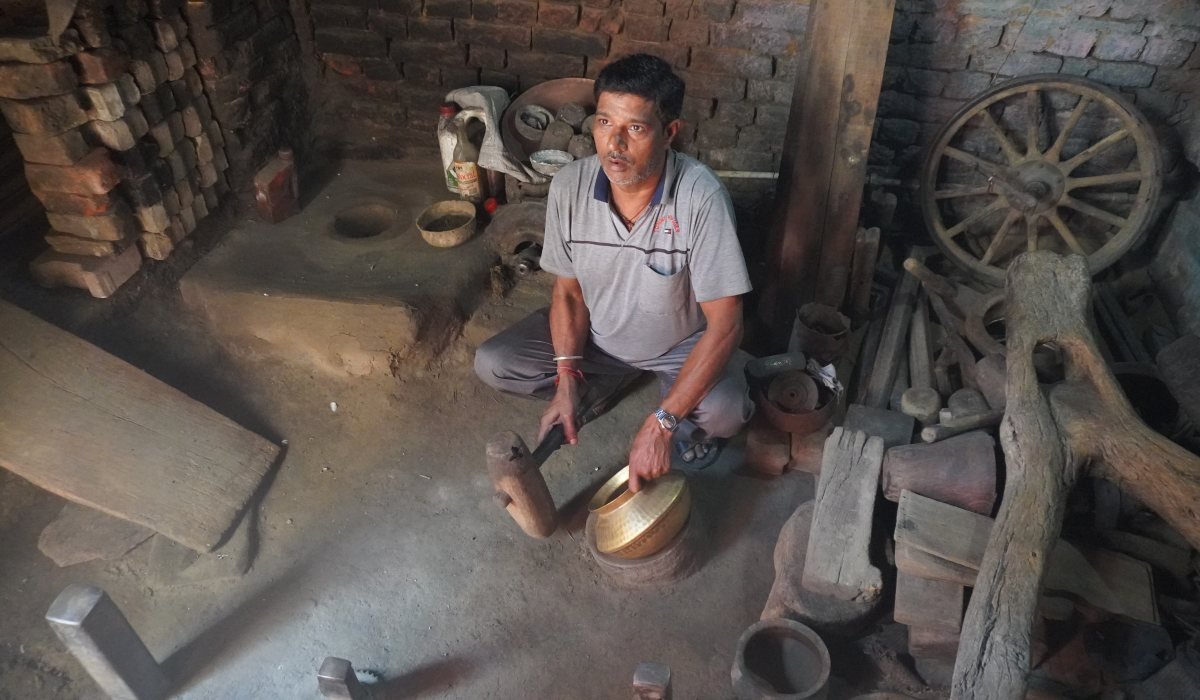
The disc is heated until it is dull red and then hammered, working from the centre outward in a spiral, over a stake. Each pass draws the metal up slightly. A team of three or four works in rotation, because the hammering is continuous and the metal cools quickly.
As bronze is worked it hardens. Keep hammering a work-hardened bowl and it cracks. So the piece goes back in the fire to anneal — heated and allowed to relax — and then comes out for another round. A small bowl might take eight or ten cycles. A twenty-six centimetre jambati takes far more, because the metal is being drawn much further.
Why the hammer marks are there
They are not decoration and they are not applied afterwards. They are the record of the process — every facet is one blow. A machine-spun bowl has none because the metal was pressed against a form rather than struck.
You can hear the difference as well as see it. A spun bowl has a thinner, shorter, more uniform note. A raised bowl has variable wall thickness, and that variability is part of what gives it a complex, long-decaying tone.
The note is not chosen
This is the part buyers find hardest. The fundamental frequency of a bowl is a consequence of diameter, wall thickness and profile. The team can aim for a range. They cannot hit a note.
Which means any supplier offering hand-beaten bowls in a specified key, to order, in quantity, is either sorting an enormous stock or selling you spun bowls. We sell hand-raised bowls with the measured note stated for the individual piece, and we do not take orders by key.
What to check when you buy
- Look inside for concentric hammer facets. A perfectly smooth interior means spun.
- Rim it. A raised bowl usually takes three or four seconds to speak and then builds.
- Weigh it against its diameter. Thin and light for its size generally means less metal and less sustain.
- Ask what the note is and whether it was measured or estimated.
A good bowl is not expensive because it is old or blessed. It is expensive because four people spent two days hitting it.